Who gets to participate in “being”? Images of refugee camps, part 1

What opportunities do people in the camps have to leave, to work, to create a future for themselves? How much does humanity lose when they are, seemingly, excluded from participating in the “ongoing event of being”?


I also wonder what happens when these places start to become “home”?

Are subjects here socialized into despair and swayed more easily to support terrorism or are they motivated by their experience to become contributors to a better world for all humanity? How does Jesus show up here?


benjaminthomaswhite's avatarSingular Things

This is the first in a series of posts about images of refugee camps. For three earlier posts about images of refugees, click here, here, and here.

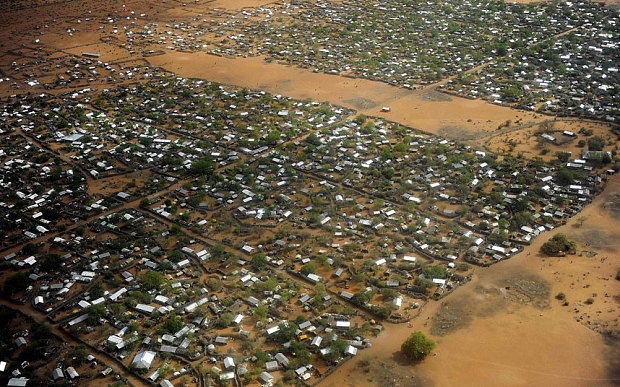
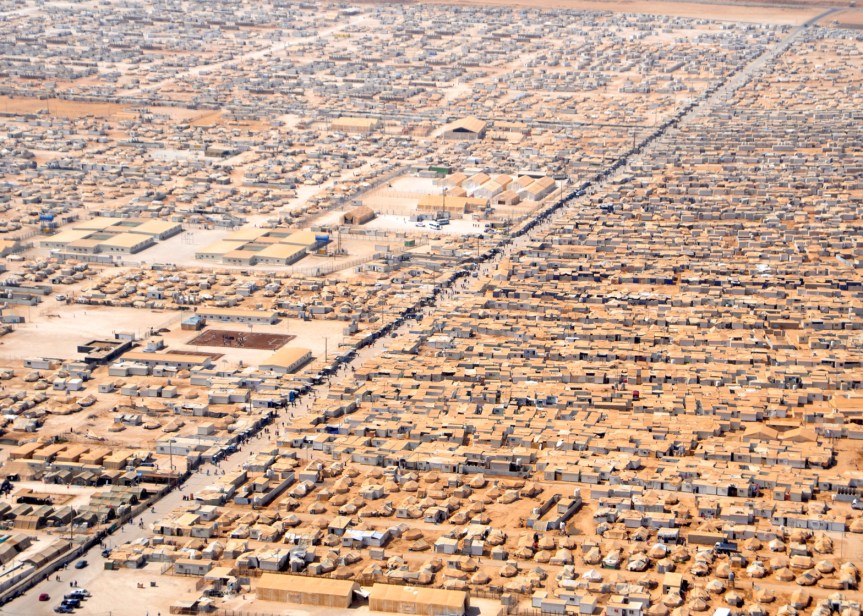
1 Zaatari Refugee Camp, Dezeen

You’ve already seen this photo, or one like it. It’s Zaatari refugee camp in northern Jordan, home to a large (though fluctuating) population of Syrian refugees—about 80,000 at the time of writing, according to the UNHCR data portal’s page on the camp, though it’s been higher. At the moment, Zaatari is probably the most famous refugee camp in the world, though there are many that are older, or bigger, or both. Politicians, diplomats, celebrities, and tourists visit it, and so do many, many journalists. That’s one of the reasons why I say that you’ve already seen this photo, or one like it: if you pay even the slightest bit of attention to the news media, your eyes have…

View original post 1,808 more words

Images of refugees, part 3: refugees at sea

Check with your grandparents before you decide what you think!

benjaminthomaswhite's avatarSingular Things

This is the third in a series of posts about images of refugees. For the first post, click here. For the second, click here.

Photographs of refugees on land often work to make both the refugees themselves and the landscapes they’re walking on interchangeable—so many huddled figures trudging across so many featureless bits of countryside. My last post explored some of the reasons for this: they’re partly to do with the choices that picture editors make, and partly to do with the standard formats of newspapers or news magazines and the cameras, lenses, and film that were typically used to take the photos that appeared in them. (Only rarely do refugees’ own views or choices come into it.) And in the post before that I wrote, more briefly, about the typical news photograph of a group of refugees in flight, burdened with their possessions. The aesthetic roots of…

View original post 1,884 more words

Immigrants, take America back!

The cover of Atlantic Magazine this month asks if America can put itself back together again. Convoluted thinker that I am, I wondered where this “again” came from and where (or who) some people want to take America “back” from (of course some of us know that it is on the brink).

When was America “together” in the first place?  If there was a time when this country was not on the brink, your ancestors may have missed it.  Some of mine were in “the home country” until the Gold Rush, and others didn’t come until the 20th Century.  On the other hand, maybe some of yours were already here.  That’s possible if you are from an old California or Texas family with a Spanish last name family, but then maybe “America” was about to invade them. Continue reading “Immigrants, take America back!”

Leadership, Jesus style

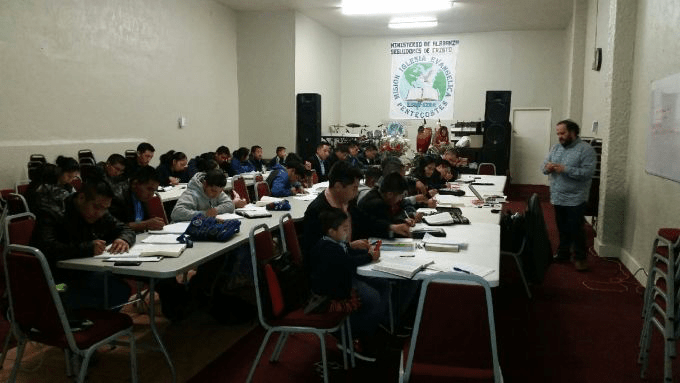
Tuesday nights in February I teach a class at a church in Oakland on “Liderazgo al Estilo de Jesús” (that’s Spanish for “Leadership Jesus’ style”).  My students are mostly tri-lingual.  And, one of the three, is likely to be one of three different dialects of Mam, a Mayan language from the highlands of Guatemala.

After my one week introduction to the story of Jesus’ leadership, I have invited guest Continue reading “Leadership, Jesus style”

They want to be leaders. Jesus has something to do with leading.

I will spend the next four Tuesday nights in Oakland with a group of immigrants from Guatemala who want to lead.  Our task together is to think about leadership in light of Jesus.

Where do they lead? If by “leader” we mean someone who shows the way for others, or someone who redefines the future, then these immigrants are already leading in multiple contexts.  Some might find it surprising to think that they lead on a global stage–even though many might consider them to be victims of globalization.  But their leadership extends beyond the local.  They lead their families who are scattered in Continue reading “They want to be leaders. Jesus has something to do with leading.”

On living a charmed life #2 — Obrigado amigos e colegas!

Two special gifts came our way last month.  And they point to larger gifts that guide our lives. A first gift came in the form of an old booklet of Brazilian recipes.  It was a reminder to cherish the prayers of our friends.  Read about that gift in another post on this blog.

The second gift was a trip to Brazil.  It was a reminder that friends and networks broaden our world.  Though we left Brazil 30 years ago, we still have Brazilian friends.  Besides the friendship, they are a mature network of people who still take us into worlds we might never have known without them.

We left Brazil a long time ago. Continue reading “On living a charmed life #2 — Obrigado amigos e colegas!”

On living a charmed life—gift #1—thanks to you!

Lois and I have been entrusted with gifts and privileges over the years.  Such things may come ultimately from God, but they are delivered through people like you.  Two special gifts  came this month and reminded me why we say “entrusted.”  We get gifts so we can use them responsibly.
The first gift was when we found an old recipe book of Brazilian recipes from a women’s meeting on our first visit back from from Brasil.
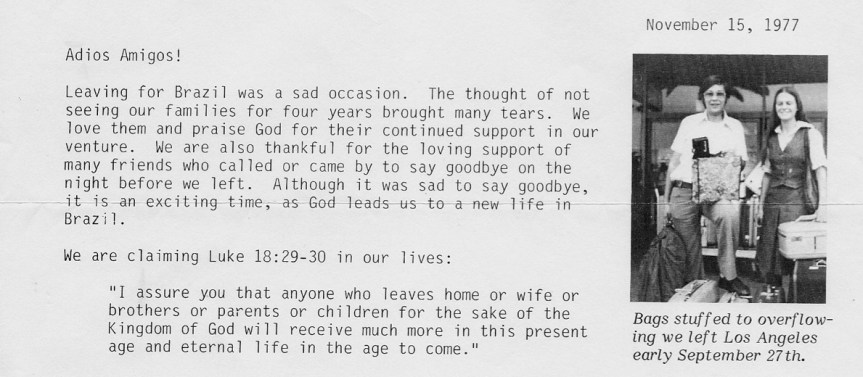
Let’s go back a few steps:  Before we got married, we decided to be missionaries.  A year after tying the knot, we moved to Brazil — 25 and 23 years old!
Leaving for Brazil

We started our family in Brazil, and then raised our daughters in Guatemala.  Some people thought we were really dedicated—giving away our lives—but we always thought we were on the receiving end, getting many more good things than we ever gave up.

The recipe book, and the prayers of friends
The first gift I got this month was an old recipe book with only five recipes.  It’s old, and typed on a typewriter.  We aren’t exactly sure when this little booklet was made. The introduction includes language that often made us feel uncomfortable because it implied that we were doing something particularly special.  It also made Brazilians out to be poor and needy, and our friends in Brazil were very much like us.  Sometimes our friends nurtured ideas of Brazil that was might have been more consistent with the Amazon jungle than with the very urban context of the two cities we lived in.  Not only was the jungle 5 hours away by plane, the cities we lived in were amazingly modern, in some ways beyond what we had experienced in the USA.  São Paulo (15 million people then) was enormous and an industrial powerhouse .  Curitiba (3 million) was a great city to live in, and a global standard setter for good urban planning.
What made this booklet a gift was also in the introduction.
Screen Shot 2015-12-13 at 9.31.18 PM
Something more important than the mis-conceptions about who we were and where we lived, was the willingness of our friends to make special efforts to pray for us.  We were the privileged ones because we were on the receiving end of the prayers of many more people than anyone we knew.  Many still pray for us.  We get all the benefits.
Its mysterious to some, but God seems to pay attention when people turn to him and cry out for help on behalf of others.  We were those “others” for whom our friends cried out to God.  It’s not like bad things never happened to us.  But it is true that the bad things never STAYED bad.  People we hardly knew kept talking to Him about us.
I have attached a link to the entire cookbook.  It has five great, and simple, recipes for Brazilian food that we still love to this day.
How to use this gift responsibly?  I think the answer is hidden behind the second gift I received recently, and I will post about that in the next couple of days.
But using this gift responsibly begins by saying THANK YOU!
You have made a huge difference in our lives.  All the joyful pictures and family joys that we post on Facebook, are because of you.  The skills we have now and use to serve others — Lois helping students at the High School to find their way to College, and me, standing as an ally for Latin Americans as they enter a world of conflict, oppression and need in the name of Jesus , so that they can offer blessing and well-being and encourage others to follow Jesus—these are special skills and we have them because you gave us a context in which to grow and develop them.  Thank you.

Migração árabe ao Brasil e influencias transnacionais

Resumo escrito desde perspectiva brasileira: A imigração árabe no Brasil

Palavras chaves:

Nahda — literature and the rise of Arab Nationalism.
Mahjar — Arab Diaspora
Liga Andaluz — Organizada em São Paulo em 1933, com o objetivo de dar continuidade ao Renascimento Literário Árabe.

An area to explore:  Arab-Jews and the migration of Arabs and Jews to the Americas.

I began by watching this video by Zvi Ben-Dor Benite of NYU about the historical roots of the reality of Arab-Jews today.

Veja também  este site brasileiro sobre Judeus Árabes

Outros escritos:
Elias Farhat, o poeta líbano-brasileiro do arabismo

A poesia árabe moderna tem raízes no Brasil


Learning to Listen to the Bible

From time to time I get to teach a class at ELET (Escuela Latinoamericana de Estudios Teológicos) in El Cerrito, California.  Most of my students are immigrants.  They are hard workers who, after a hard day of work, come to spend a couple of hours and work hard to pay close attention to the text and let the Bible examine them.

I am learning to keep a blog where I hope to keep my Students engaged.  To be honest, I still can’t figure out if it helps them, but it sure helps me gather my scattered thoughts and focuses me on helping them listen to the Bible.

One of the things that has surprised me Continue reading “Learning to Listen to the Bible”

Todos Santos Cuchumatán in Oakland, CA

A few weeks ago my student Mario invited me to the ninth birthday celebration for his church in Oakland where he is a leader in training.

IMG_3268

The church is made up of immigrants from just one village in Guatemala:  Todos Santos Cuchumatán.

That Sunday at Iglesia Eben-Ezer, I thought about the meaning of the gospel in light of a gathering of 800 Mam speaking Christians in Oakland.  Their story signals a surprising and dramatic reversal in the direction of Christian mission and it should affect how we understand the gospel. Continue reading “Todos Santos Cuchumatán in Oakland, CA”